Pump Strainers
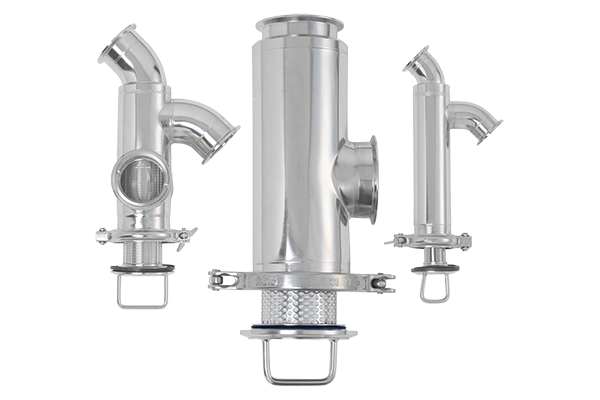
Renowned for their durability and ease of cleaning, we proudly offer the widest selection of hygienic Y strainer and L strainers in both standard and high-capacity configurations.
Hygenitec™
Renowned for their durability and ease of cleaning, we proudly offer the widest selection of sanitary strainers in both standard and high capacity configurations.
WHAT IS A SANITARY STRAINER?
A sanitary strainer is a piece of equipment that removes large particles from smaller particles required in the food & beverage and pharmaceutical industries. Furthermore, these strainers must maintain a 3A Certification to ensure the purity of the consumable products while allowing for ease of maintenance and cleaning.
Industrial sanitary strainers are essential to a safe and clean hygienic application, which is why we offer strainer customization. With Unibloc, you can choose between strainer size variations and mesh options in order to address processing needs. We even offer a choice between tempered glass or acrylic dual sight glass. The special requirements and application of sanitary strainers means you need a manufacturer you can trust to accommodate your needs.


From the Blog
View BlogCIP vs. COP: Which Sanitation Method Works Best for Your Pump Technology?
Understand the difference between clean-in-place and clean-out-of-place pump sanitation— and why it matters for your bottom line.
Read Blog6 Reasons to Consider an AODD Pump for Your Hygienic Process
Sometimes pump performance problems do not start at the pump. Rather, they start at the spec sheet, with the wrong pump picked for the job or the right pump set up the wrong way. In a recent webinar, Caleb Summers, Lead Application Engineer at Unibloc® Hygienic Technologies, discussed where air-operated double-diaphragm (AODD) pumps perform best in a hygienic process and what newer pump designs have changed about the conversation. Here are six reasons to consider one for your application.
Read BlogPreventing Cavitation in Hygienic Pumps
A cavitating pump tells you it is failing before the maintenance log does. The sound is unmistakable; the damage compounds quickly, and on a hygienic processing line, the consequences extend beyond the pump itself.
Read BlogUpcoming Events